So... should I get SayWhat?™ Single Use Adhesive Stencils, ReUseAble™ mylar Stencils,
or Vinyl Appliqué
(stick on vinyl cutouts)
Here's some detailed information on how they compare, and some Frequently Asked Questions..
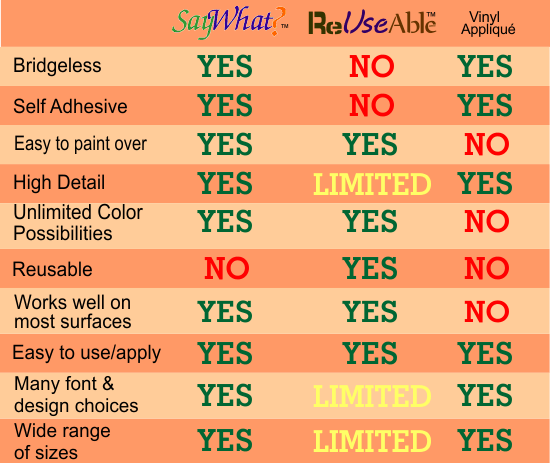
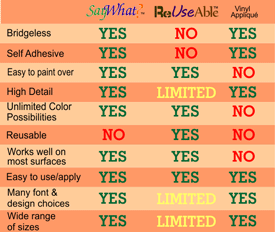
Click on chart at right for a quick comparison
|
|
 |
|
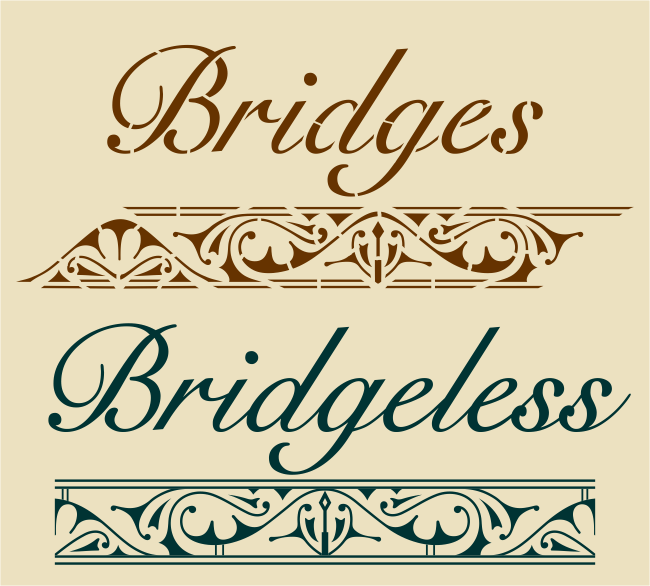
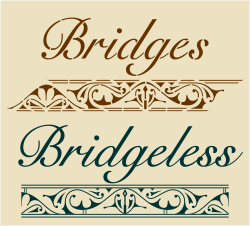
| SayWhat?™ masking stencils are entirely bridgeless |
|
ReUseAble™ stencils, made from 7 mil mylar, are durable, but require BRIDGES:
|
You can finish your project in one pass.. You save time, and the self adhesive feature reduces "bleed" under the stencil edge- your results look clean and polished. In fact, this is the same process used by professional signmakers.
Also, many decorative designs, which might normally need several overlays, can often be painted in one pass.
See our short video below for how the product works. |
|
To hold the letter centers and larger areas in, and create a product that can hold up to repeated use, bridges are required, which tend break up the flow of the design. As a rule, the more bridges, the sturdier the design, but we look at each custom project separately.
A large part of our design process is to place bridges where they are least noticeable. Some simple designs may not require bridges. |
|
|
 |
Frequently Asked Questions
• How much does it cost?
Most SayWhat?™ Single Use word and lettering projects can be produced using our exclusive Design Your Own page. Cost is only $5.88 per foot, and we offer discounts on larger orders.
For more complex text layouts and/or graphics and decorative images, it is best to use our Estimate Form above, or email us.
We will send you a proof via e-mail or other method before you finalize your order.
We can work from your description, images, or examples from online sources such as Pinterest. We have completed literally thousands of projects and will do an equally great job with yours!
Custom design work starts at $25 |
|
ReUseAble™ stencils generally run about 50-75% more than an equivalent SayWhat?™ single use stencil, due to additional setup required.
There is a minimum $30 order total for custom designed ReUseAble stencils (can be several combined projects). |
• How do I apply it?
It's pretty and easy, click here for a copy of our instructions. (In PDF format). We also include complete instructions with every order and a sample piece if applicable.
• What if I make a mistake with a SayWhat?™
Literally 99%+ of our SayWhat? customers get excellent results the first time. We send you complete instructions and at least one sample to practice with. We want you to succeed with your project.
 Our NO FAULT GUARANTEE: If your SayWhat? single use stencil mask project doesn't turn out as you expect, for any reason, we'll replace it FREE..., including standard U.S. domestic shipping. Our NO FAULT GUARANTEE: If your SayWhat? single use stencil mask project doesn't turn out as you expect, for any reason, we'll replace it FREE..., including standard U.S. domestic shipping.
ReUseAble™ all other products are warranted against initial defects.
• How will I know what it looks like?
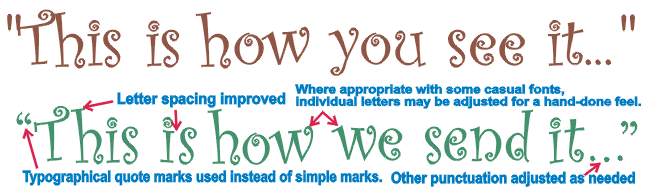
If you Design Your Own you will see how your text will look in your chosen font, and be given accurate size information. The font previewer will give you a good idea, but we will normally improve the layout at no additional charge, Shown are just a few of the things we routinely adjust
If you use our Estimate Form we will send you a proof of your project for approval. You will be able to make corrections and changes as needed before we do the final production. |
|
• How long does a ReUseAble™ stencil last?
ReUseAble Stencils are made from a durable 7 mil mylar. The number of repeats you can get from a ReUseAble stencil depends on a number of factors, including the complexity of the design, the type of finish you are using - for instance, textures are harder on the stencil than paints- how you clean and store it, etc. But in most cases, using proper stenciling techniques and care in handling, you should be able to get dozens or even hundreds of stenciled prints before it needs replacing*.
We also have specialty materials available for other applications, though none are longer lasting than our 7 mil material
*However we cannot guarantee any particular number of uses.
• What type of designs are possible?
With SayWhat?, almost any font can be used, at sizes down to 1/2" tall or less, and virtually any special character or
design can be created. There's literally millions of options.
Many complex decorative designs can be created using one overlay |
|
With ReUseAble™ stencils, the font choices tend to be more limited. Though complex fonts are possible, simpler fonts tend to work best. Also, there is typically a minimum letter height- it can vary with the font, but about 1" is the smallest we recommended.
Decorative designs generally need to be simplified somewhat because of the need for bridges |
• What if I want a font or design you don't show?
Talk to us - we have thousands available, and we have access to many more. We can even do most foreign languages, musical notes, fancy first letters, Greek, Asian, Cyrillic, etc. We have an extensive library available of shapes such as stars, moon, stylized tools, road signage, and international symbols, as well as Japanese script. We can also set up the lettering in curves, circles, arches etc, in fact about any shape you can imagine words can take. See some of our example pages for ideas.
• How big or small can you make stencils?
With SayWhat?™ stencil masks there's no real limit to size, we've created projects covering thousands of square feet. We cut in manageable portions you piece together as needed. We can also cut letters well under 1",
ReUseAble™ stencils can be up to 28x40" |
• How long does it take to process my order?
From the time we get your final OK, allow 2-3 business days for cutting, plus shipping time. In most cases you'll have your order in hand in 7 days for less. Express cutting service and shipping is also available,
• How about Vinyl Appliqué?
Another option for quality looking text and graphics is to have the design cut out of self adhesive colored vinyl, which you then stick on to your surface. This works quite well for certain situations- in fact, many commercial signs are made this way- and the application is fairly quick since you skip the painting step. We can make, and even suggest, vinyl stick on letters, but only where appropriate-feel free to ask. |
APPLICATION:
The big plus of stick on vinyl is speed of application. Smaller vinyl letters can be applied very quickly in many cases, especially on surfaces designed for their use (see surfaces below). However, larger letters can be difficult to position and apply, particularly over 3 inches or so. |
COLOR:
Limited choice of colors, and mixing colors adds to the cost. No shading possibilities, and it can add a lot to the cost if you mix colors. Vinyl can have a cheap plastic look up close. Edges can lift, and the whole design can shrink over time, leaving a dirty edge.. |
| |
SURFACES/LONGEVITY:
Stick on vinyl will only adhere to certain surfaces. It is designed to work best on very smooth or specially prepared finishes, such as glass, enameled masonite, foam or gatorboard, finished metals (aluminum, steel etc.) vinyl banner material, and the like. It sticks OK to regular wall paint and smooth or finished wood for interior use, however it would not hold up for outdoor use on these surfaces.
It won't stick to fabric, rough, or unfinished wood, stucco or other masonry, or most other porous or highly textured surfaces. Most vinyl is rated 5-7 years indoors and 3-5 yrs outdoors. |
REMOVAL:
Stick on vinyl may leave a difficult to remove residue when you eventually want to remove it. It can't be painted or refinished over, it has to be peeled or buffed off. |
| |
COST
Using stock colors, cost is typically 25% more than single use stencils. |
| |
|
|